
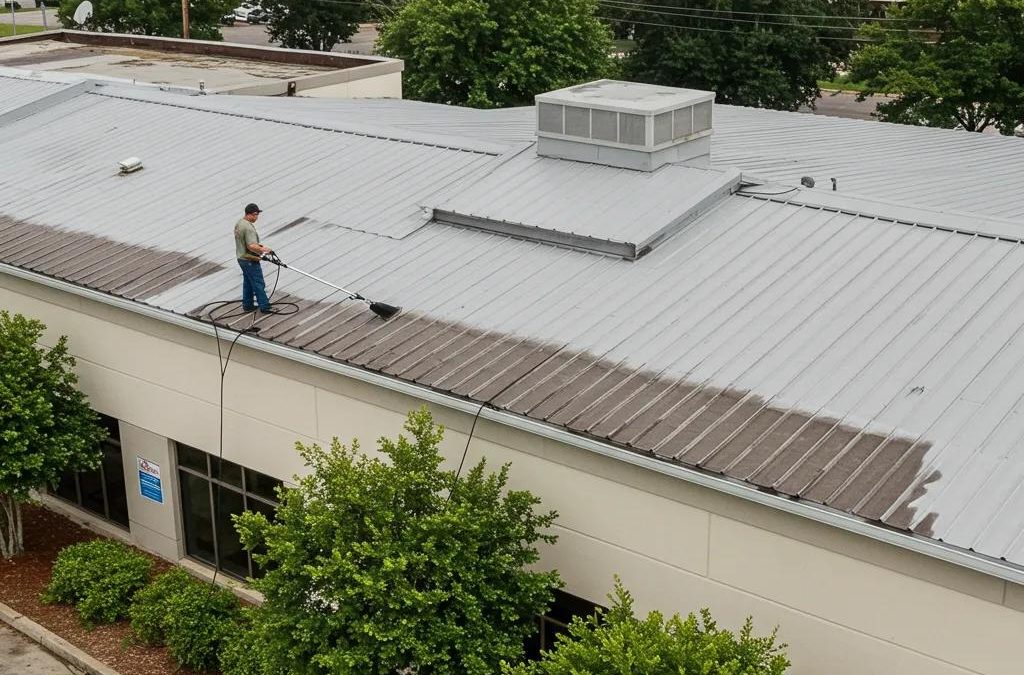
Low pressure roof cleaning, commonly called soft wash, uses targeted biodegradable cleaning agents and low-pressure application to remove algae, mold, mildew, and organic staining from commercial roofs while preserving roofing materials. This method relies on chemical action—kill and rinse—rather than abrasive force, which makes it particularly valuable for property managers who need to protect roof longevity and avoid premature capital expenditures. Facility owners in Baton Rouge face a climate that accelerates biological growth, and choosing a controlled, low-pressure approach reduces the risk of granule loss, membrane damage, and warranty conflicts. This article explains the commercial benefits of soft wash, contrasts it with traditional pressure washing, and outlines a practical process and cost-to-ROI framework tailored for Baton Rouge’s humid environment. You will find actionable maintenance cadences, material-specific guidance for shingles, metal, and membrane roofs, and comparison tables and checklists designed for decision-makers evaluating lifecycle savings and compliance risk.
What Are the Key Benefits of Soft Wash Roof Cleaning for Baton Rouge Commercial Buildings?
Low pressure soft wash roof cleaning extends asset life by chemically eliminating biological growth that degrades roofing materials, improving curb appeal, and reducing long-term maintenance costs through non-abrasive treatment. The mechanism combines specialized biodegradable solutions that penetrate and kill root structures of algae and mold with low-pressure application that avoids mechanical erosion, which results in a cleaner surface and preserved material warranty conditions. For commercial properties, the primary business outcomes are deferred replacement costs, reduced emergency repairs, and improved tenant or customer perception—each tying directly into property ROI and lifecycle planning. The following table condenses benefit entities against their mechanisms and expected short- and long-term return attributes to help facility managers compare strategic outcomes.
This EAV-style table clarifies that targeted soft wash treatments address both immediate appearance and measurable lifecycle factors. Understanding these comparative attributes helps procurement and facilities teams prioritize cleaning intervals based on risk and capital planning. The next section compares soft wash to traditional pressure washing to surface the risk profile for commercial roof types.
How Does Soft Wash Extend Roof Longevity and Protect Your Investment?
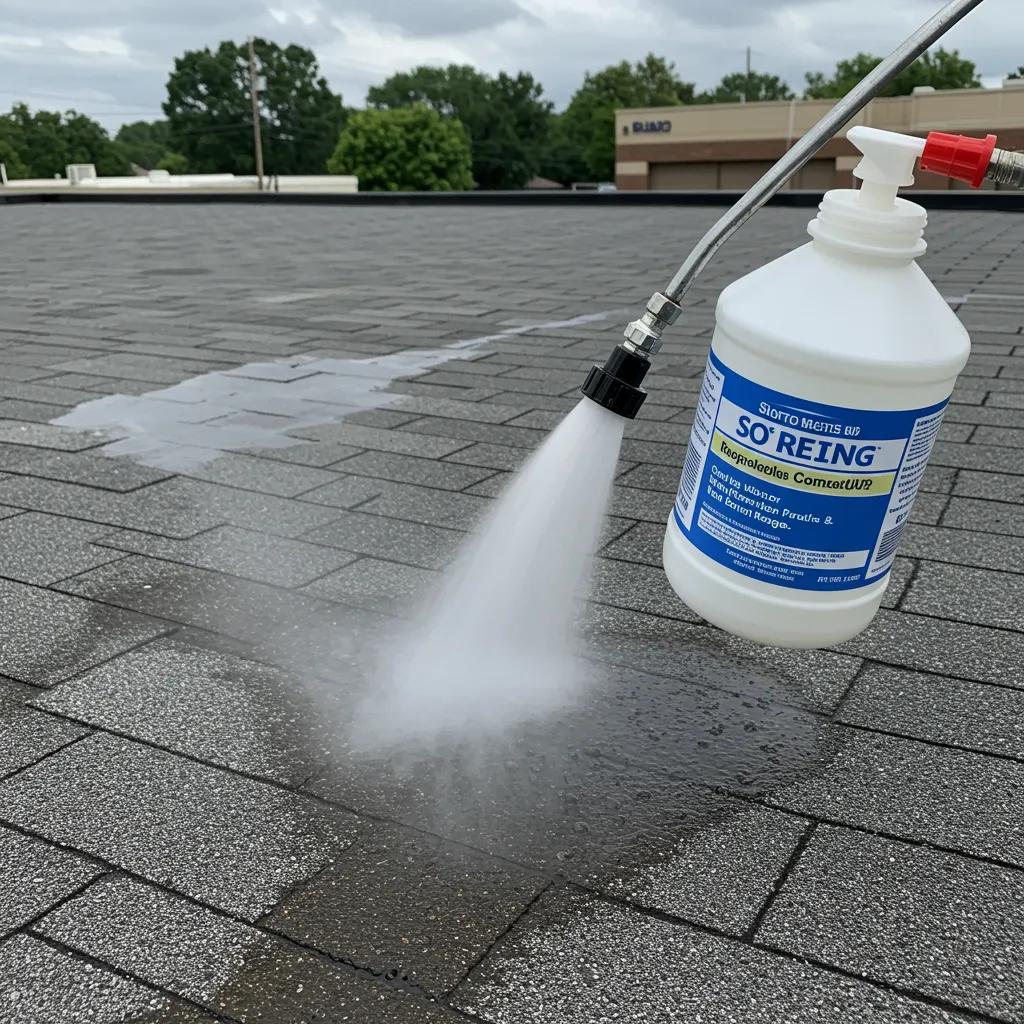
Soft wash extends roof longevity by killing biological organisms at their roots without abrading protective layers, which prevents the micro-pitting and granule loss that accelerate shingle deterioration. The active chemistries break down organic matrices and inhibit regrowth for an extended period, which reduces moisture retention and the likelihood of membrane breakdown or hidden leak pathways. By removing growth chemically, soft wash reduces the frequency of reactive repairs and spreads maintenance costs over longer intervals, offering a clear lifecycle advantage for budget-conscious owners. Comparing a routine soft wash schedule to an aggressive pressure-clean-and-repair cycle makes it easier to quantify deferred replacement dates and project cash-flow benefits for capital planning.
In What Ways Does Soft Washing Enhance Commercial Property Curb Appeal?
Soft washing restores uniform roof appearance by eliminating black streaks, moss patches, and lichen that create a perception of neglect and reduce perceived asset value. For customer-facing facilities—retail centers, offices, hospitality properties—clean roofs contribute to overall aesthetic standards and can influence tenant retention and new-leasing velocity. Descriptive before/after documentation (photos with alt text referencing roof condition and treatment date) supports marketing and leasing teams when justifying maintenance budgets. Visual improvements from soft wash are also a tangible metric when calculating sales or occupancy uplifts tied to exterior maintenance investments.
Why Is Soft Wash Preferred Over Traditional Pressure Washing for Commercial Roofs in Baton Rouge?
Soft wash is preferred for commercial roofs because it replaces mechanical abrasion with a chemistry-driven kill phase, minimizing physical risk to shingles, membranes, and flashing while delivering sustained control of organic growth. Pressure washing can dislodge granules, strip coatings, and force water under flashing or into seams, which increases leak risk and may trigger warranty disputes with manufacturers. Soft wash’s lower risk profile aligns with manufacturer guidance and long-term cost reduction strategies, particularly for properties with warranty-sensitive roof systems. The following comparison table summarizes material-specific risk/benefit trade-offs to help decision-makers choose the recommended method.
This table demonstrates that soft wash consistently reduces structural risks across common commercial roof materials, while pressure washing introduces material-specific hazards that can increase lifecycle costs. The next subsection lists typical risks of high-pressure methods to highlight why many facility managers opt for soft wash.
- Common high-pressure cleaning risks for roofs include physical abrasion that removes protective layers, water forced under flashings causing leaks, and disturbance of sealants that lead to accelerated failure.
- High-pressure methods can void manufacturer warranties or complicate claims when cleaning methods are not aligned with roofing specifications.
- Water intrusion during pressure work may increase short-term remediation costs and cause interior damage or downtime for occupied commercial spaces.
What Are the Risks of High-Pressure Roof Cleaning for Business Properties?
High-pressure cleaning risks include granule loss on asphalt shingles, compromised lap seams on membranes, and inadvertent water intrusion under flashing that can cause hidden deterioration and interior damage. These mechanical failure modes translate into repair costs and may accelerate the need for capital replacement, which impacts lifecycle budgeting for commercial portfolios. Additionally, high-pressure methods increase the probability of voiding manufacturer or installer warranties when abrasive techniques contradict recommended care instructions. Recognizing these risks is essential for procurement teams negotiating service scopes and for facilities managers who must protect long-term asset integrity.
How Does Low Pressure Soft Wash Provide a Safer, More Effective Cleaning Solution?
Low pressure soft wash applies diluted biodegradable agents at controlled flow and dwell times to chemically disrupt and kill biological growth, followed by gentle rinsing, minimizing mechanical stresses to roofing materials. Application protocols emphasize correct mix ratios, targeted coverage, and controlled dwell time to ensure effective organism kill while protecting adjacent assets and landscaping. This method relies on trained technicians using containment and runoff mitigation techniques to satisfy environmental concerns and preserve landscaped areas. By prioritizing chemical efficacy and operator competency, soft wash delivers consistent cleaning outcomes with lower risk to roof systems.
What Role Do Biodegradable Cleaning Agents Play in Soft Wash Safety?
Biodegradable cleaning agents are formulated to target biological organisms while breaking down into neutral components that reduce environmental persistence and risk to vegetation when applied with proper containment. Selecting chemistry with proven biodegradability and using run-off controls—such as absorbent berms, targeted rinsing, and protective covering for sensitive plants—mitigates collateral impact. Trained applicators also document pre- and post-treatment conditions to demonstrate compliance and minimize regulatory exposure for commercial properties. Business owners should ask potential contractors about specific agent types and containment measures when evaluating proposals.
How Does Baton Rouge’s Climate Impact Commercial Roof Cleaning Needs?
Baton Rouge’s warm, humid climate creates optimal conditions for rapid growth of algae, mold, and mildew on roof surfaces, increasing frequency and severity of contaminant accumulation on commercial buildings. High humidity and regular rainfall maintain surface moisture and support spore germination, while shaded roof areas and debris from surrounding vegetation further accelerate colonization. For facility managers, this means cleaning cadence and treatment selection must account for faster re-growth cycles and higher biological load compared with drier climates. The following paragraph explains the biological mechanism that links humidity to accelerated roof colonization and how that insight informs maintenance planning.
Why Does Humidity Promote Algae, Mold, and Mildew Growth on Commercial Roofs?
Humidity promotes growth because spores require moisture and organic films to establish and proliferate; warm temperatures then accelerate metabolic activity of algae and fungi, which form pigmented biofilms that trap moisture and degrade surface materials. Shaded roof planes, debris accumulation in gutters, and organic particulates provide micro-environments where spores thrive, leading to visible streaks and porosity increases. Facility teams should monitor shaded areas and implement targeted cleaning of gutters and adjacent vegetation to reduce inoculation sources. Recognizing these environmental drivers helps managers choose preventive and reactive cleaning intervals that align with local climatic risk.
How Can Soft Wash Effectively Remove Organic Growth Without Damaging Roofs?
Soft wash effectively removes organic growth by applying a measured chemical treatment that penetrates and kills organisms, then releasing residues with a controlled rinse that preserves surface coatings and granules. For Baton Rouge conditions, technicians often recommend initial treatments followed by scheduled follow-ups—commonly annual to biennial depending on exposure—to prevent re-establishment. Integrating roof cleaning with routine gutter maintenance and vegetation control reduces re-inoculation and extends the period between treatments. Planning proactive soft wash cycles around seasonal growth patterns helps minimize emergency interventions and supports predictable maintenance budgeting.
What Is the Typical Process for Commercial Low Pressure Roof Cleaning in Baton Rouge?
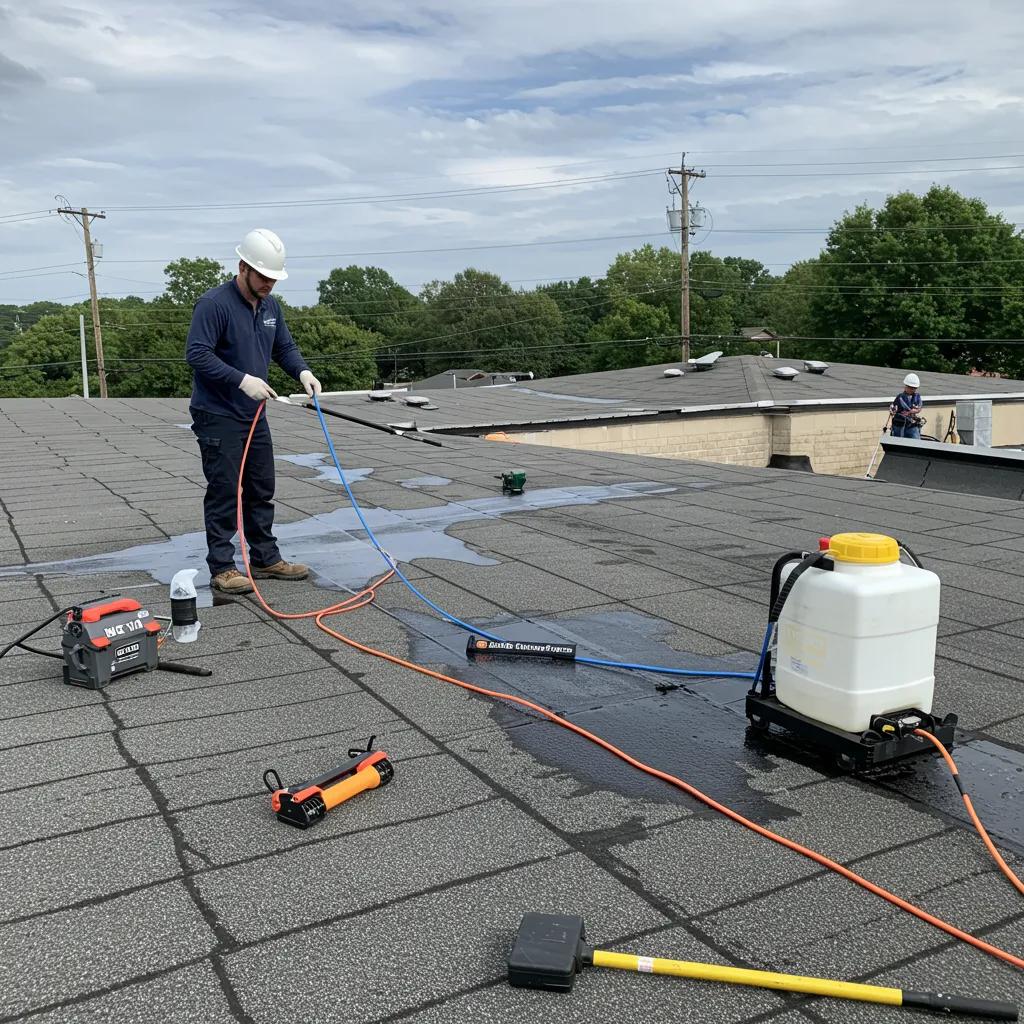
A typical commercial soft wash process begins with a documented pre-cleaning assessment, proceeds through controlled application of biodegradable solutions with monitored dwell times, and concludes with a post-clean inspection that includes photographic documentation and recommended maintenance cadence. This process emphasizes asset protection—covering rooftop equipment, testing a small area first, and deploying containment to protect landscaping and stormwater lines. Field crews follow manufacturer-aligned protocols to preserve warranties and use scaffold or fall-protection procedures appropriate for commercial sites. Below is a numbered process checklist that facility managers can use when evaluating proposals and monitoring execution.
- Site assessment and risk documentation: Identify fragile areas, rooftop equipment, access points, and potential runoff paths.
- Containment and protection setup: Cover HVAC intakes, plants, and sensitive surfaces; install runoff controls.
- Application with correct mix and dwell time: Apply biodegradable soft wash at tested ratios and monitor kill time.
- Gentle rinse and cleanup: Controlled rinsing to remove residues; restore containment and document condition.
- Post-clean inspection and reporting: Deliver before/after photos, maintenance recommendations, and warranty notes.
This stepwise list helps procurement and facilities teams compare provider scopes on equal terms and sets expectations for execution quality and deliverables. Next, the table outlines the typical inspection checklist used during pre-clean assessment to protect property and landscaping.
Pre-clean assessment checklist for commercial sites:
A documented assessment reduces surprises during work and provides an audit trail for warranty and insurance considerations. After formalizing the scope and safeguards, professional delivery standards and scheduling play a key role in ensuring minimal disruption to operations.
For project scheduling and professional execution, many businesses prefer to work with turnkey commercial cleaning firms that coordinate safety, documentation, and quality assurance. Elite Cleaning Services is an example of a commercial janitorial and facility cleaning provider that performs comprehensive site assessments and issues project quotes or inspections for facility teams seeking a documented scope. Facility managers should request written inspection reports, clarified warranty treatment steps, and a clear schedule that minimizes impact to tenants and operations. This operational discipline ensures safety and helps translate cleaning work into measurable lifecycle benefits.
How Is a Pre-Cleaning Assessment Conducted to Protect Property and Landscaping?
A pre-cleaning assessment begins with a walk-through to identify fragile roofing areas, rooftop equipment, and sensitive landscaping, and includes photographic documentation to establish baseline conditions. The assessment catalogs access constraints, required fall-protection equipment, and any repair work that should precede cleaning to avoid exacerbating existing damage. Protecting adjacent assets—securing HVAC intakes and covering vegetation—reduces liability and environmental risk during application and rinse phases. Clear communication of these findings to stakeholders sets expectations and informs final pricing and scheduling decisions.
What Are the Key Steps in Applying Soft Wash Solutions Safely and Effectively?
Key steps include mixing the biodegradable solution to manufacturer-recommended ratios, applying with low-pressure equipment in controlled passes, monitoring dwell time for biological kill, and performing a controlled rinse that directs runoff to containment. Technicians should wear appropriate PPE, use boom or rope access where necessary, and employ overspray controls to protect nearby assets. Quality crews validate kill with follow-up inspections and document results with before/after imagery. This disciplined approach balances chemical efficacy with environmental safeguards to achieve consistent outcomes without damaging the roof system.
How Does Post-Cleaning Inspection and Warranty Support Business Owners?
Post-cleaning inspection provides a formal record—photos, treatment notes, and recommended follow-up intervals—that facility managers use to validate service quality and support warranty compliance if future issues arise. Many commercial providers include limited service warranties or performance guarantees that specify re-treatment windows for biological re-growth; these deliverables should be captured in a written scope. Clear post-service reporting also aids in capital planning by proving the effectiveness and timing of interventions, which informs replacement timelines. Owners should request explicit documentation of treatment chemistry and process steps to preserve manufacturer warranty protections.
How Much Does Commercial Soft Wash Roof Cleaning Cost in Baton Rouge and What Is the ROI?
Commercial soft wash pricing depends on square footage, roof type, severity of contamination, access complexity, and required safety measures; typical per-square-foot ranges vary but are influenced most by roof pitch and infestation intensity. Rather than a single flat rate, providers often price projects by combining base per-square-foot labor/chemistry with add-ons for containment, mobilization, and difficult access. The ROI framework compares one-time cleaning costs against deferred replacement expenses and avoided repairs, demonstrating that periodic soft wash can postpone major capital outlays and reduce emergency repair budgets. The following table breaks down common cost drivers and their impact to help facilities teams estimate probable project costs and expected savings.
This breakdown helps facilities staff model budget scenarios and compare vendor proposals on consistent terms. The ROI comes from extending roof service life and reducing emergency repairs; in many cases, a modest recurring cleaning budget offsets a portion of replacement cost and reduces lifecycle spending.
- Typical pricing considerations should always be accompanied by an onsite assessment to produce reliable cost estimates.
- When estimating ROI, include deferred replacement value and avoided emergency repair costs to get a realistic lifecycle perspective.
- Insurance, lease obligations, and tenant satisfaction metrics can further tilt the ROI in favor of regular soft wash maintenance.
What Factors Influence the Cost of Low Pressure Roof Cleaning for Businesses?
Factors influencing cost include total roof area, roof pitch and geometry, contamination severity, required safety equipment, and presence of rooftop assets that need protection. Difficult access increases labor time and safety requirements, while heavier biological loads may require stronger chemistries or multiple passes. Environmental controls for runoff and landscaping protection also add to mobilization costs, particularly on properties with sensitive vegetation or intricate stormwater systems. Careful pre-clean assessment and transparent scope definitions reduce the likelihood of mid-project change orders and provide clearer budgeting for facility managers.
How Does Soft Washing Deliver Long-Term Savings and Protect Property Value?
Soft washing reduces total lifecycle cost by arresting biological degradation that otherwise accelerates roofing material breakdown and increases leak risk, thus delaying costly replacement projects. Improved roof reflectivity and cleanliness can modestly reduce HVAC load on certain membrane types, contributing to operational savings that compound over time. Enhanced curb appeal supports tenant retention and recruiting, which indirectly preserves rental income and property valuations. These combined effects produce a measurable ROI when compared with reactive repair strategies that fail to address underlying biological drivers.
What Are the Most Common Questions About Commercial Soft Wash Roof Cleaning in Baton Rouge?
Facility managers commonly ask about recommended frequency, warranty interactions, contaminant scope, and applicability across roof types; concise, documented answers streamline procurement and help set realistic expectations. Clear guidance reduces procurement friction and ensures that cleaning programs align with manufacturer and insurance requirements. The following short Q&A lines address these operational points and are optimized for quick reference by decision-makers considering soft wash services.
How Often Should Commercial Roofs Be Soft Washed in Baton Rouge?
Commercial roofs in Baton Rouge typically require cleaning on an annual to biennial cadence depending on exposure, surrounding vegetation, and observed regrowth rates; properties with heavy tree cover or shaded planes may need more frequent treatments. Regular inspections after the wet season help determine whether an annual schedule is warranted, whereas exposed rooftops may maintain acceptable condition on a two-year cycle. Facility managers should document outcomes to refine intervals across a portfolio, balancing cleaning costs against visible degradation rates. Proactive scheduling reduces emergency call-outs and spreads maintenance costs predictably.
Will Soft Washing Affect My Roof’s Manufacturer Warranty?
Soft washing generally aligns with manufacturer recommendations when performed using approved chemistries and low-pressure techniques; conversely, high-pressure washing is more likely to void warranty terms. Retaining written documentation of the process, chemicals used, and before/after photos supports warranty claims if issues arise later. Facility teams should request vendor confirmation that methods comply with roofing manufacturer guidance and keep a treatment log as part of asset records. This documentation protects owners and simplifies warranty interactions.
Can Soft Wash Services Remove All Types of Roof Contaminants?
Soft wash is highly effective on biological contaminants—algae, moss, lichen, mold—and on many organic stains that respond to biocidal chemistries, but it is less effective on non-organic stains such as oil, rust, or structural deterioration that require specialized remediation or repair. A pre-clean assessment differentiates biological growth from substrate damage or pollutant staining and indicates when repair or alternative remediation is necessary. When non-organic stains are present, coordinated repairs or targeted treatments should be included in the scope. Clear scope definition prevents mismatched expectations and ensures cost-effective outcomes.
Are Soft Wash Roof Cleaning Services Available for All Commercial Roof Types?
Most commercial roof systems—including asphalt shingles, metal roofs, and common single-ply membranes like TPO and EPDM—can be safely cleaned with soft wash methods when technicians apply material-specific protocols and containment measures. Certain specialty coatings or aged systems may require consultation with the roofing manufacturer or a repair contractor before cleaning to avoid unintended damage. Selecting a provider who documents methods and demonstrates competency across roof materials helps ensure safe, warranty-aligned service. For procurement, include material-specific clauses in the service agreement to clarify responsibilities and re-treatment terms.
For facility teams ready to convert these insights into action, consider engaging a qualified commercial cleaning partner to schedule an assessment and receive a written ROI estimate. Elite Cleaning Services, a turnkey commercial janitorial and facility-cleaning firm, provides site assessments, documentation, and project quotes that help owners compare lifecycle scenarios and procurement options. Requesting a documented inspection and a clear scope of work helps business owners move from planning to an implemented maintenance program with predictable outcomes.